

Writing retreat or getting words on the page

Updated: May 9
(join post with the MAVE Lab)
—
In academia, writing is not optional and, if you don’t particularly enjoy it that’s totally fair, but it might be worth reconsidering your career path. Writing is how we communicate our research, contribute to scientific progress, and stay accountable to the taxpayer that often funds our work. Yet, with everything else demanding our time (e.g., teaching, supervising, admin duties), writing is often the first thing to fall by the wayside.

And let’s be honest: this struggle does not magically disappear the higher up the ladder you climb. From undergrads drafting their first thesis to seasoned academics juggling five different projects, finding focused time for writing is a shared challenge.
That is why we, at the BEAM and MAVE labs, decided to hit pause and organize a writing retreat. The goal? To create the time, structure, and support our students (and yes, ourselves too) needed to make meaningful progress on their writing. Spoiler: it worked better than we expected!
If you’re considering something similar for your group, there’s no one-size-fits-all formula—but here’s what worked well for us.
Step 1: clarify the purpose before the retreat
A writing retreat is not a vacation, and it is not for tweaking the last 10% of a finished draft. It is about generating new writing, making solid headway, and gaining clarity on a piece that is still in development. To get the most out of it, two things need to happen before anyone even shows up:
Make expectations clear
Before the retreat, we made it a point to ensure that everyone knew exactly what was expected of them. This wasn't about vague intentions to "catch up on writing", it was about defining a focused, realistic goal.
Each participant was asked to:
Pick one writing project with a clear goal.
Decide on a realistic, focused outcome (e.g., “Draft Methods & Results for Paper X” or “Complete full Introduction section”).
Show up prepared with all results, figures, and key references ready to go.
That last point is crucial. The retreat isn’t the time to troubleshoot code, rerun analyses, or dig through folders for missing references. If people aren’t prepared, they’ll waste precious writing time chasing files or getting stuck on formatting. It’s all about removing friction before you arrive.
Share a pre-Retreat checklist to send participants before arrival
To help everyone show up ready to hit the ground running, we circulated a simple checklist ahead of time:
Choose your project and define your writing goal
Have all figures/outputs ready in final or near-final form
Bring your reference library (EndNote, Zotero, Mendeley… or even just PDFs in a folder)
If possible, have a rough outline ready
Don’t plan to multitask, this is dedicated writing time
This level of preparation might seem a bit rigid, but it is what sets the retreat apart from just “working from home.” With everyone focused, organized, and aligned, the group creates a collective momentum that is hard to replicate in everyday academic life.
Step 2: structure the Retreat for maximum focus
We found that having a simple, repeatable daily structure was key to maintaining momentum without overwhelming anyone. Here’s a rough outline of what a typical day looked like:
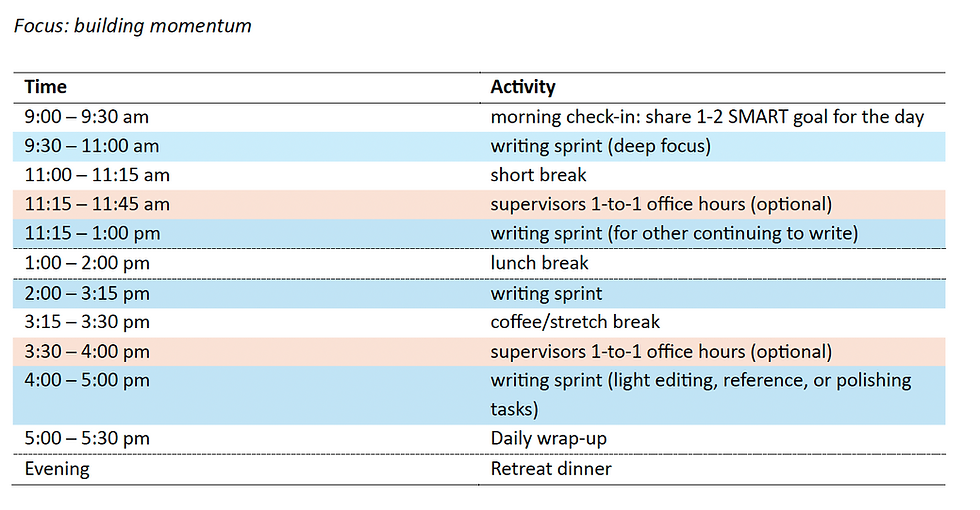
Goal setting: each day starts with participants sharing their SMART goal (Specific, Measurable, Achievable, Relevant, Time-bound). This could be: “Write 500 words of Discussion section” or “Edit 3 paragraphs of my thesis intro”.
Writing sprint: A focused, no-distraction block. Phones silent, no emails, just writing. For the final sprint of the day, we encouraged participants to shift to lighter tasks like editing, referencing, or polishing figures, as energy levels naturally dipped.
Breaks: coffee, stretch, casual chat about anything but work. These pauses help reset the brain and keep energy levels up. We also found that adding a bit of movement, like a group walk or a quick workout, worked wonders (let’s just say there was a lot of leg soreness by day two).
Optional 1-on-1 check-ins: a chance to get quick feedback or unblock a section with a supervisor.
Lunch and dinner: a relaxed, shared meal. Helps with bonding and keeps the energy up.
Wrap-Up & accountability: everyone shares what they accomplished. This creates a low-pressure accountability loop and helps people track progress.
We kept this format consistent across all three days. It offered just enough structure while still giving people room to manage their own time and flow.
Step 3: Foster group bonding (it is more important than you think)
Writing retreats are not just about productivity, they are also about building a community. And for research groups that are remote, scattered across institutions, or just have not had much face-to-face time, these shared experiences are incredibly valuable.
Here’s what made the difference for us:
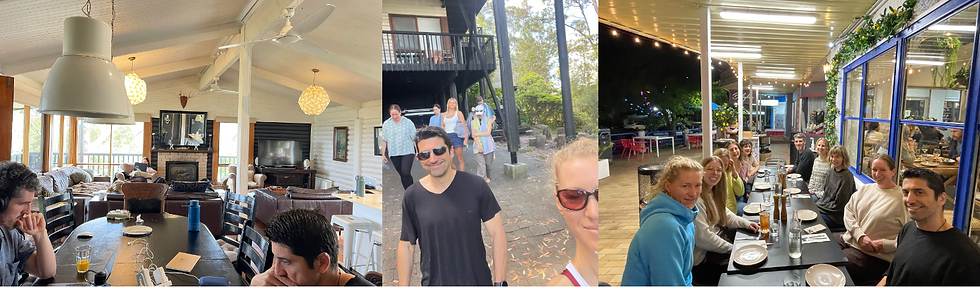
Shared meals: cooking or eating together is underrated. It creates organic time to chat, laugh, and debrief.
A change of scenery: if you have the budget, renting a quiet house outside the city helps. A cozy, distraction-free setting does wonders for focus and connection.
A lab mascot: Yes, really. We brought along Koda, our group’s young Aussie Shepherd. Not only was he the best icebreaker, but he also brought a calming, playful vibe to the group. When it is difficult to start a conversation with people you never really met in person, having him around helped ease any initial awkwardness.

Having a space where people feel relaxed and seen (not just as “PhD #4”) fosters a stronger group culture. And honestly, that’s what makes people want to keep writing with each other later on.
Step 4: the outcomes and keeping the writing habit alive
While we saw measurable progress with most participants accomplishing more than they expected, the real value was in the momentum it created. Being part of a group all working toward similar goals gave everyone a sense of shared purpose. The “we’re in this together” vibe really pushed people to dig in and keep going.
Of course, once you’re back in your regular routine, it’s easy to slip back into old habits. That’s why post-retreat follow-up is key.
Once solution we adopted was to set up a simple system to maintain momentum: online “Shut Up and Write” sessions. Here’s how we do it:

Someone posts in the lab Slack or Teams channel: “Writing sprint at 10 am, here’s the Zoom link.”
People join in, cameras off, and quietly work for 25-30 minutes (Pomodoro-style).
At the end, a quick check-in: “Did you hit your goal?”
People can leave or stay for another round.
It’s low-pressure, easy to coordinate, and helps recreate the retreat's structure in a virtual space.
Final thoughts: writing together works
Organizing a writing retreat is not about reinventing the wheel. It is about giving people the time, space, and structure they need to do something that is both essential and often neglected: to write.
With a bit of planning and a shared commitment, it is possible to create an environment where writing stops being a solitary chore and becomes something supportive, even enjoyable.
So, whether you're in a lab group, a department, or a cohort of fellow PhD students, consider planning a retreat. It might just be the thing that gets your next paper across the finish line.
Frédérik Saltré, & Katharina J. Peters
--


Comments